Chania is the city everyone falls for, and the fall is justified. The Venetian harbour curves out to its much-rebuilt lighthouse, the domed Mosque of the Janissaries sits right on the quay, and the lanes behind hold leather workshops, wine bars and washing lines in roughly equal measure. Come at 7am in June and you get the waterfront to yourself, the White Mountains often still snow-streaked behind the rooftops. Come at noon and you queue behind a cruise group for a table you did not really want.
The town is only a third of the story. Chania is also Crete's western province: Balos lagoon and Falassarna on the west coast, Elafonisi tucked into the south-west corner, and the Lefka Ori filling the whole middle of the map. Samaria, the gorge everyone has heard of, drops 16 km from the Omalos plateau down to the Libyan Sea. On the south coast, Paleochora and Sougia work to ferry timetables rather than clocks. None of it is undiscovered. Most of it is still worth the effort.
Distances deserve respect here. Elafonisi is 75 km from Chania town and the last stretch is slow mountain road; Balos involves either a boat from Kissamos or a dirt track your hire-car contract probably forbids. The sensible move is to split your stay: a few nights in town for the food and the evening volta, then a few nights west around Kissamos or south in Paleochora, so the famous beaches become morning strolls instead of day-trip marathons.
Towns worth your time
Chania old town
Skip the harbour-front tavernas and walk two streets back. Splantzia, the old Turkish quarter around Square 1821, is where the town still belongs to locals: coffee under the big plane tree, and the church of Agios Nikolaos wearing both a bell tower and an Ottoman minaret — it has been Dominican monastery, mosque and Orthodox church in turn. Further east, Halepa was the diplomats' suburb; Eleftherios Venizelos's house is a museum there, and the old Tabakaria tanneries on the waterline now hold a few fish tavernas. The covered Agora market has been shut for restoration since 2022 and is still shut; the summer 2026 target slipped, the works deadline was extended at the end of July 2026 to 31 October, and the reopening is now being talked about for December — so do not build a morning around it.
Kissamos
About 40 km west of Chania, Kissamos — also signposted Kastelli — is a working town rather than a postcard, and more useful for it. This is the port for the Balos boats, the supermarket stop before Falassarna, and the centre of a serious farming plain: the olive oil from nearby Kolymvari holds its own PDO, and small wineries sit in the hills behind. Rooms cost noticeably less than in Chania town. The long town beach is ordinary; the point of staying here is what lies 20 minutes in every direction.
Paleochora
Paleochora is 75 km south over the mountains — call it 90 minutes driving, or 2 hours on one of KTEL's three daily buses — and occupies its own small peninsula, sand on one flank and pebbles on the other. The town kept its 1970s ease. Tavernas take over the main street on summer evenings, everyone swims before breakfast, and from mid-May a morning boat runs to Elafonisi every day except Sunday, which beats driving there by some margin. Stay three nights at least; day-trippers see the beach but miss the evenings, and the evenings are the point.
Sougia
Sougia is what south-coast Crete looked like before anyone built much: one road in, a long pebble bay, a scatter of rooms and tavernas, mountains straight behind. Samaria hikers know it as a ferry stop — Anendyk boats link it with Agia Roumeli and Paleochora between April and October, and the afternoon bus back to Chania is timed to meet the boat. The E4 path west reaches Lissos, an ancient healing sanctuary, in under two hours on foot. No sand, barely any shops, patchy phone signal in places. That is the recommendation.
The coast
Balos
The lagoon photographs so well that people forget the logistics. Either take a boat from Kissamos port — big vessels, a couple of hours at the lagoon plus a stop at Gramvousa islet and its Venetian fortress — or drive the 8 km dirt track from Kaliviani and walk 20 to 30 minutes down, then back up in full sun. Most hire-car contracts quietly exclude that track. The water is shallow, warm and pale over white and pink sand. In August the sandbar resembles a festival campsite by noon; May, June and late September are the sane windows.
Elafonisi
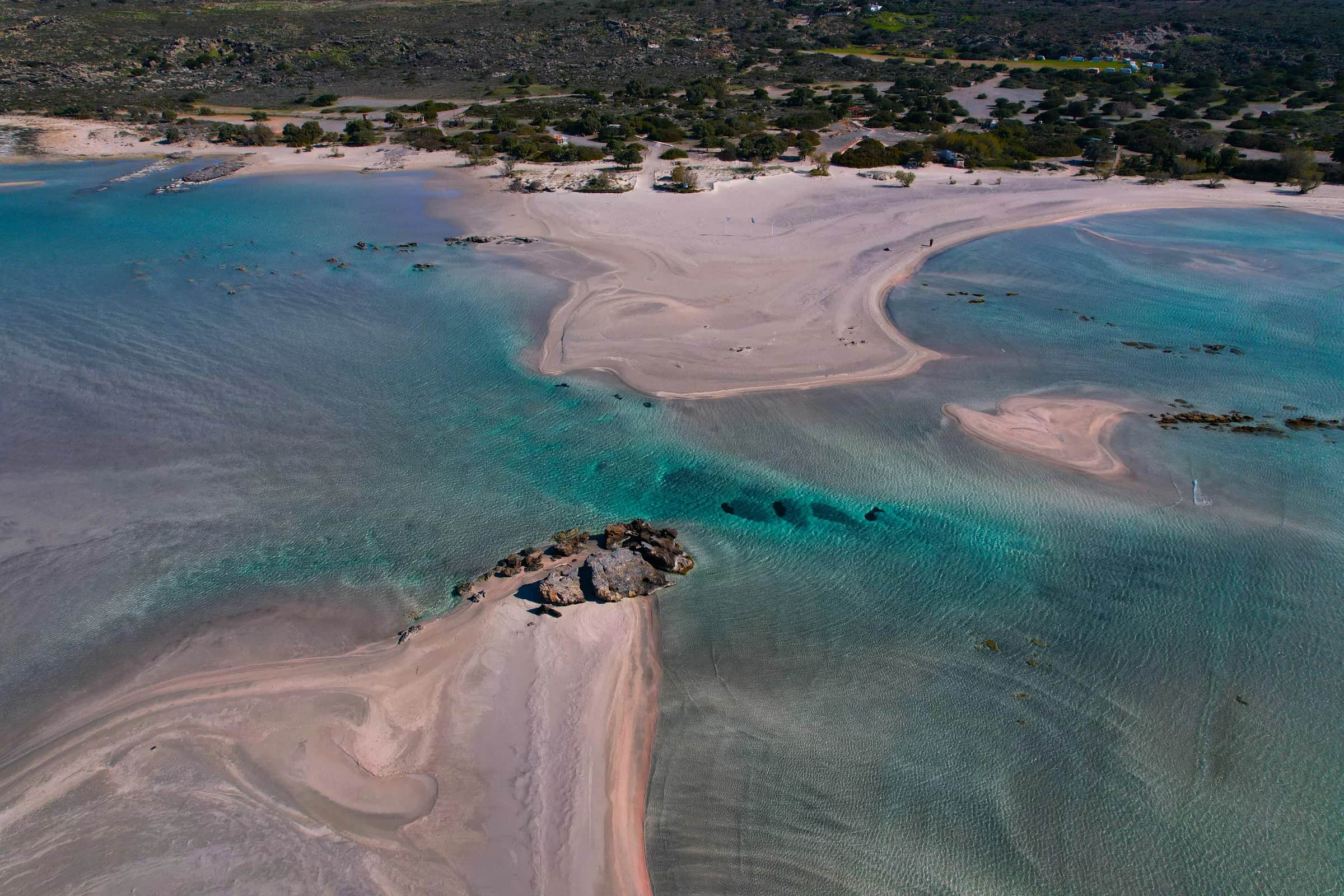
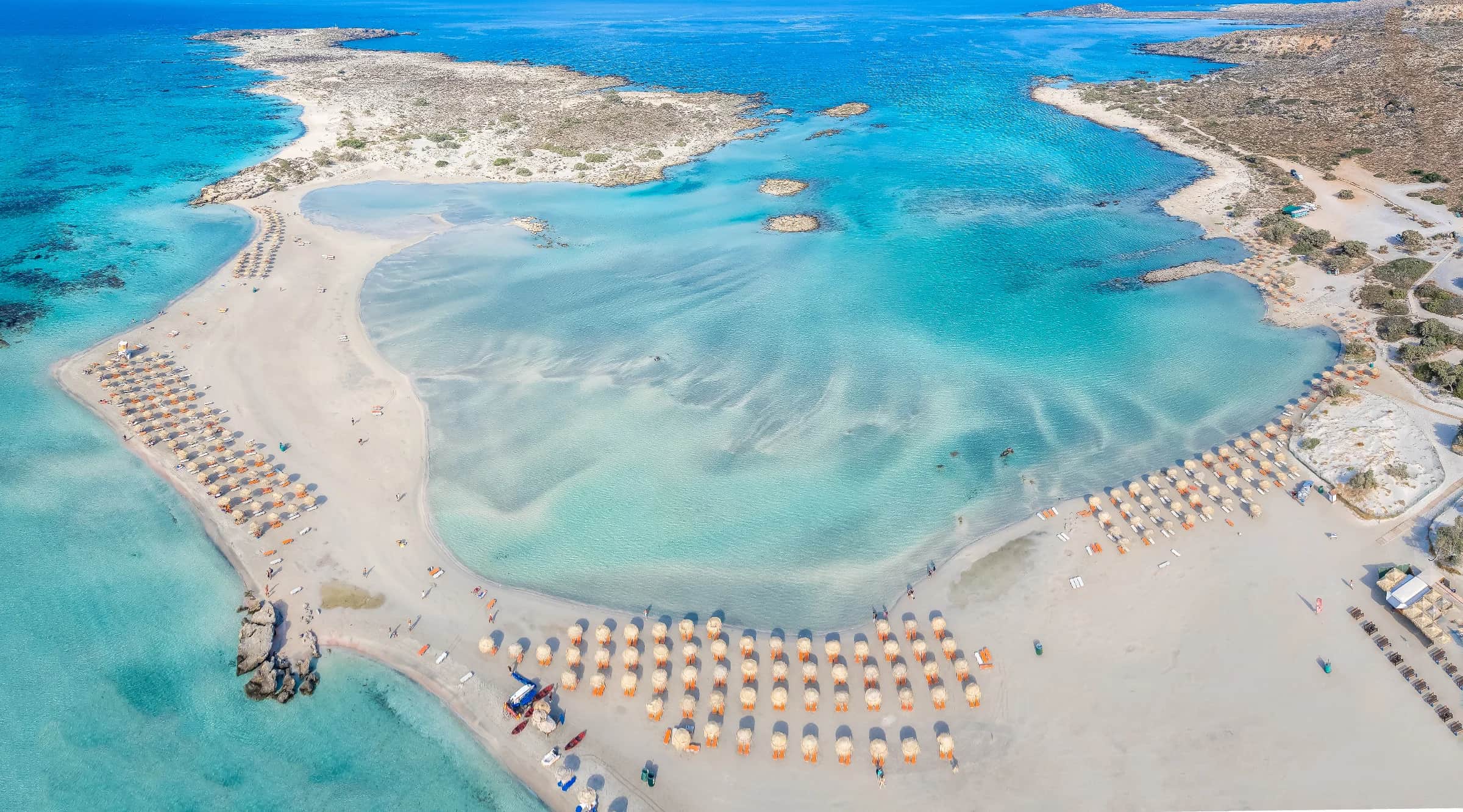
A 75 km drive from Chania town into the island's south-west corner — allow up to 2 hours — or one seasonal KTEL bus out each morning. The sand carries a genuine pink tint in places, crushed shell rather than marketing, and the lagoon is shallow enough to wade across to the islet opposite, which suits small children well. It is on every day-trip itinerary in western Crete, with sunbed ranks to match. Arrive before 10am or after 4pm in July and August, or come in June. The Paleochora boat is the most pleasant approach of all.
Falassarna
Falassarna, 59 km west of Chania and 17 km beyond Kissamos, is the honest one: a huge stretch of pale sand facing due west, open to real waves when the wind is up, with tomato greenhouses and vineyards behind instead of boutiques. The sunsets are the best in western Crete because the horizon is all sea. Ruins of the ancient harbour town sit at the northern end, oddly unvisited. Bring your own shade for the southern coves. When the wind blows hard, swim elsewhere — the currents are not a rumour.
Seitan Limania
On the far side of the Akrotiri peninsula, past the airport, this narrow zig-zag inlet holds a wedge of white pebble-sand between high cliffs. The catch: you park on the clifftop and scramble down a steep goat path in flip-flop-hostile terrain, then share the beach with actual goats, who will open your bag for sandwiches. Photogenic, tiny, and rammed by mid-morning in summer. Go early on a shoulder-season weekday or give it a miss entirely — Falassarna repays the same effort far better.