Lasithi is the part of Crete most visitors run out of holiday before reaching. The package crowds thin somewhere past Malia, and by the time the road drops down to Agios Nikolaos the island has changed register: drier hills, carob trees, towns that face the Gulf of Mirabello rather than the charter traffic. This is the province of Spinalonga and its abandoned leper colony, of a farmed plateau at 840 metres, and of Vai, where around 5,000 palm trees stand behind the sand.
The geography does odd things out east. The Lasithi Plateau is a flat green disc of potato fields and orchards ringed by the Dikti mountains, reached by hairpins from either coast. Above the village of Psychro, at about 1,025 metres, the Dikteon Cave stakes its claim as the birthplace of Zeus; the climb from the car park is steep and takes 15 minutes or so. Down on the south coast, Ierapetra grows vegetables under a sea of greenhouse plastic and calls itself the southernmost town in Europe. Nobody nearby argues.
Treat Lasithi as two trips. The western half — Agios Nikolaos, Elounda, Kritsa and the plateau — sits within day-trip range of the north-coast resorts. The far east does not. Sitia is a winding 70 km beyond Agios Nikolaos, and Vai, Zakros and Xerokambos lie further still; they reward two nights, not a dash. Outside August you will have long stretches of this coast largely to yourself, which on Crete has become the rarest thing going.
Towns worth your time
Agios Nikolaos
The provincial capital arranges itself around Lake Voulismeni, a near-circular pool locals swore for generations was bottomless; a university survey in 2000 measured it at just under 49 metres. The channel joining lake to harbour was dug in the late 1860s under the Ottoman governor of the day, and the bridge over it is where the evening stroll ends up. It stays a working town year-round, which is its charm — you can swim in town at Kitroplateia, all small pebbles and shallow water. Skip the lakefront tavernas at dinner; they charge for the view. Walk two streets uphill and eat better for less.
Elounda & Plaka
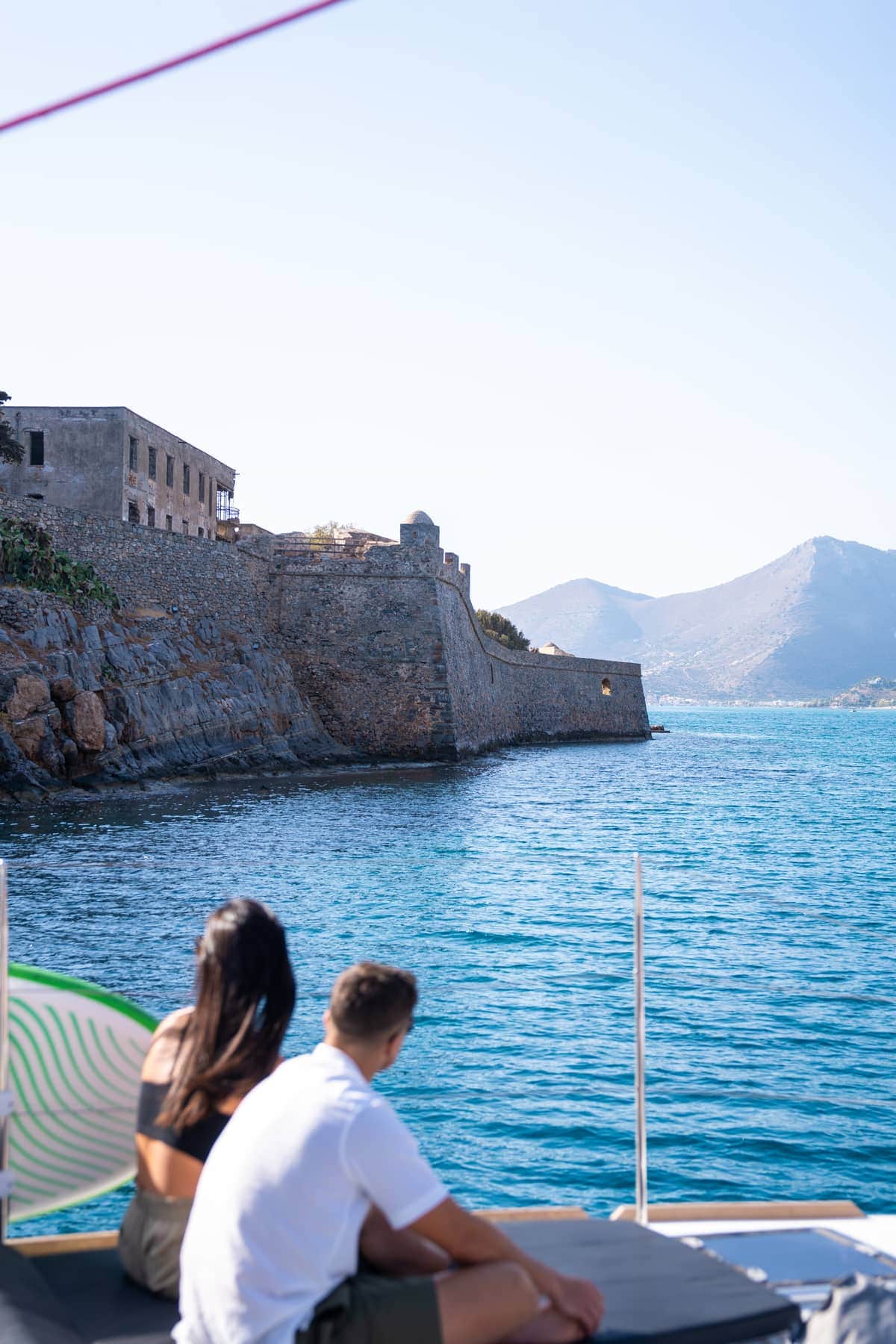
Elounda is where Crete keeps its most expensive hotels, and the village square moves at coach-party pace by late morning. Persist. From the causeway by the old salt pans you can walk out onto the Kolokytha peninsula past the sunken traces of ancient Olous, visible through the water on a calm day. Plaka, 5 km north, keeps its shingle beach and grilled-fish tavernas facing Spinalonga; the crossing takes about 10 minutes from here. The fortress island held a leper colony from 1903 to 1957, and it is genuinely affecting if you go on the first boat, before the tour groups land.
Sitia
Sitia is the town tourism forgot to ruin: tiered streets above a long, rarely crowded sand beach, the Venetian Kazarma fortress on the hill — a 13th-century barracks whose name is a corruption of Casa di Arma — and evening life that runs on locals. A small airport takes a handful of Athens flights a week. Use it as the base for the far east: Toplou Monastery sits about 10 km along the Vai road, and at Exo Mouliana the Richtis Gorge trail drops 4 km past a waterfall of about 20 metres to a pebble beach. Ask for xygalo with your dakos.
Ierapetra
The southernmost town in Greece is a working place first: the greenhouses ringing it export vegetables across the continent, and the seafront gets on with life whether you visit or not. There is a small Venetian fort, Kales, guarding the harbour, and a house in the old quarter where Napoleon supposedly slept in 1798 — a story locals tell better than historians can back. Boats leave for Chrissi island, but disembarking there is now banned in season to protect the dunes; you circle, swim and come home. For a proper beach day, Makrigialos is half an hour east.
The coast
Vai
Around 5,000 Phoenix theophrasti palms — Europe's largest natural palm grove — grow right down behind the sand, 24 km east of Sitia. It photographs like the Seychelles and fills accordingly: from mid-July, arrive before 10am or after 5pm, or accept the queue for the paid car park. The forest itself is fenced and protected; the postcard angle is from the steps up the southern rock. In May or October you may share it with a few dozen people, which changes everything.
Voulisma (Istron)
The bays around Istron, a short drive southeast of Agios Nikolaos, are the region's easy win: pale sand, water shading from white to deep blue, and swimming as gentle as Crete gets. Voulisma is fully organised and busy by 11am from June onwards; the smaller coves either side absorb the overflow. On a windy day the whole gulf chops up — save it for a still one.
Xerokambos
The island's far southeastern corner, at the end of a winding road past Zakros: a string of beaches running white sand through coarse pebble, a scatter of tavernas and rooms, and no nightlife whatsoever. Pair it with Kato Zakros, where the Gorge of the Dead — named for the Minoan burial caves in its cliffs — walks you about 2.5 km down to the ruins of the last Minoan palace found on Crete, dug in 1962, a few steps from the water.
Kolokytha
Not a drive-up beach. Park near the Elounda causeway and walk the peninsula path past the remains of ancient Olous to a sandy cove looking back at the village. Mornings are quiet; from midday the trip boats arrive, some with speakers. No taverna, little shade, so carry water. The walk over the dry headland, sea on both sides, is half the point.